
Creation: the Fruition of Will
- Samuel Bird
- Jan 23, 2024
- 9 min read

Creation: The fruition of the will
Samuel Bird
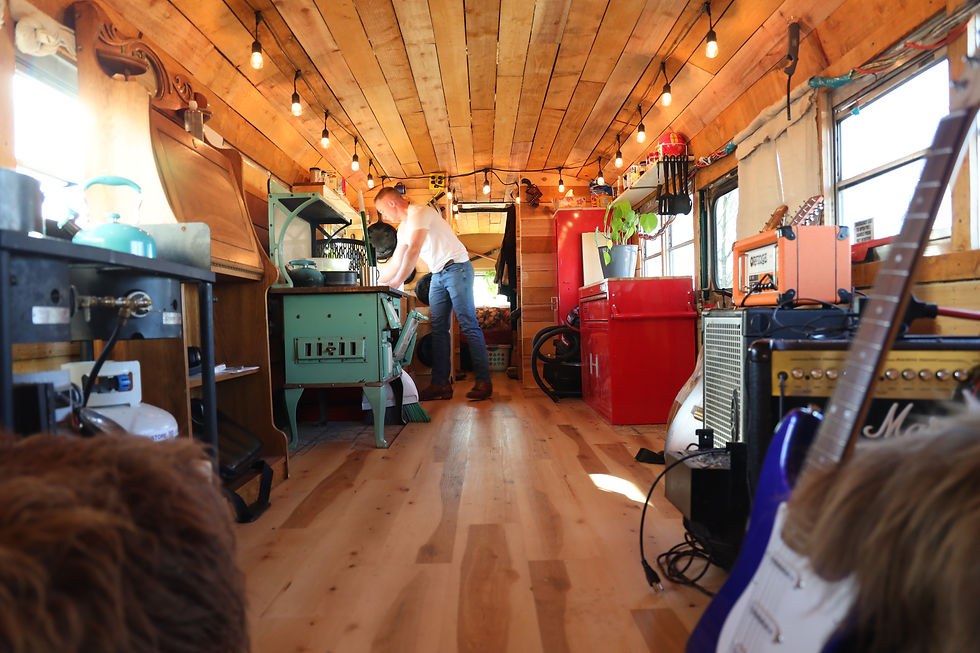
I watched as my father dragged in lumber, paint, trim, and piping to attempt to turn our ramshackle small home somewhat livable. When he wasn’t looking, I would sneak away his tape measure, hammer, or even some boards. When I turned six years old, it became an obsession of mine. I would go to the back of my family’s property and take old wood, buckets, tarps, and anything else I could find and turn it into a home of my own. In the winter I would do the same process. I piled snow high, packed it, hollowed it out, and even stacked ice up as a chimney. I didn’t just want a place to stay, there was something about my will that drove me to create. When I was in my early teenage years, I became fascinated with music. I found a favorite artist, styles, genres, and sounds. This revering could not stay at idolisation, but something about my will necessitated that it became something I did. When I began to learn instruments such as the guitar and piano, I didn’t learn existing songs. It seemed like a waste of time to me because someone already done it before. I only wrote songs or did improvisation on the spot. Something from deep inside me was coming out into the world via this tonal and rhythmic expression. As I later found a focus on my existence and the rationale effort I wanted to respond to it with, I found a deep love for philosophy. Reading Plato, Nietzsche, and Wittgenstein alone was enlightening and opened me up to an internal dialogue and years of experience I had for my entire life. Reading their words, thinking about them, and even writing about them was not enough. I wanted to philosophize on my own. Over this last year, I bought everything needed, did a rough plan, and began the labor of creation on my home. I'm writing this sitting in it now. More than pride, it is a point I made to the world that I am free to act in it, and have succeeded.
In your mind comes a vision. You weigh its value and parts to see what properties you can change. Before experience, you reason what each of these parts will do, and what the overarching value that will be added to your life. More than just what it does, maybe you want it to have intrinsic value, so you make it beautiful or in homage to something you are fond of. It then becomes in part what you desire, but then also a little bit of who you are. When the world sees it, they will see you. After a life spent hidden within the confines of your skull, a part of you will venture out to be known. This deep perceiving and understanding of you could bring a deeper connection you strive for. Or, on the other hand, it will give you power over the world around you. The deep suffering you feel will now not be in vain, or even perhaps will be assuaged. Your creation, its magnanimity, and its effects flow through your mind, as it also becomes clear it only exists in the inner world and much of what you want from it will come from it being transplanted in the world around you. You pick up pen and paper, instrument and warm up, or hammer and nail. You then do what humans do best: you labor. By your efforts, you bring about a structuring of the randomness of the world, in accordance with the valued structure that exists only in your mind. Sweat on brow, calluses on hand, and weariness of mind remind you of the great cost of this pursuit, but you are reminded of the great profit at hand. Perhaps you even see yourself as one that creates for its one sake. You go back and forth between the image in your mind and the structure that is beginning to take place before you. You start over again, think of new methods, and reassess your primitive resources, all in an effort to make this endeavor in the world, align with your mind. It becomes clear that every part of your vision can’t be brought into the world, but perhaps you could create that which matters most to you. You begin to evaluate in a limited world in the age-old process of sacrificing. What you would have loved to have, falls by the wayside by what was most dear to you. Distractions come in your way, internal dialogues of failure, and a barrage of reminders from the world around you that making cosmos from chaos is an uphill battle. You storm on, and on, and on, until at last, there it is. Before you know it, your creation is before you. There may be critics and naysayers that have a thought to share, but this creation, in all its simplicity, inadequacy, and humility, has one sacred component that makes it nearly divine to you. It is real. You wouldn’t have to go far to find someone with a comparable quality of idea, if not a better one, but when you look around, this is the only one left from a mind into the world for all to behold. This property of existence is also joined with the fact that your cognition and will come together to participate in the world. Nothing about what you built was pulled from you by the world, but was what you pushed out into it.
As the transference of fact from internal world to external, creation via consciousness stands on the opposite side of learning. It becomes clear the impression the world has on us, and now, we can impress our more deliberate will on it. This creative aspect flows deep through our bloodlines. Poets, architects, strategists, musicians, builders, and parents went about making something that had never existed in the world before, now exist. It is as human as humans can be on their best day. This creation is the fruition of living deliberately, as it turns a passive existence into a white-knuckling of being involved with the wonderful mess around us. In terms of that which is a fact, and yet can be of use to the human endeavor, creation is at its peak. Perhaps even the current conversation that seems to have come to an end and the issues that face us can be best responded to with this creative view.
During a particularly deep pit in my life, a close friend came along. This friend was agreeable to my naturally domineering nature, gentle when I was difficult, and informative when I needed to know something. As a person who believes in God, I find this person to be a God-send during a time when it was most needed. They showed the most important quality a friend can have, they stuck around. Over and over again, they would show up to things, be present, and be committed to the friendship. I am used to any relationship being a wonderfully fleeting flash in the pan, but this dear friend of mine, though they have moved far away, still reaches out to me. Despite my effort, our relationship was pretty one sided. I was definitely the one who was served the most. There was one thing I was able to add to their life, however. They would talk about their family, what their view of the “good life” was, and how to follow through on it. There was this particular secession of school, job, marriage, and children that seemed particularly rigid. I can certainly see merit in tradition, but this exactness seemed to be too sharp for them to handle, and frays were showing. I took my time to deeply understand the situation at hand and to make sure I didn’t jump to any conclusions, but over time it became more clear. This friend had a surety that there was a right answer, and to not know it or bring it about, was a large, personal moral failing. Like a good human, she found herself not reaching these stringent marks. These rules that would have been fabulous guide posts, became walls for her to beat herself against. When I had my thoughts clear, I sat down with her and began a dialogue.
“I got it.” “The job, I am so happy for you.” “Thank you, it is just the next step.” “But you are excited right?” “Yeah, I guess. It is more just the next step.” “This job, do you like it?” “or course, I will make a ton of money.” “I am glad to hear it, but do you like the work itself?” “It is good enough.” “Are there other jobs you may like more?” “Well of course, but they don’t make as much money as this.” “What do you need all the money for?” “It is what you need. A nice house, a nice car, and the right lifestyle are not cheap!” “And why do you need that lifestyle?” “It is just what we do. That is what my dad did. He drilled it into me that that is what a good life is.” “Are there other right ways of doing it?” She looked down for a moment and considered. “Honestly, I don’t think so.” I thought about what she said, what I wanted to say, and how to bridge that gap. “You know, I have something I have wanted to tell you for a while now.”
This dear friend of mine struggles from a lack of distinction between discovery versus creation. There is this idea that certain large parts of being human are facts that lie out in the world for us to find. As I have made abundantly clear in my writings, value, beauty, meaning, and perception don’t happen anywhere but within a mind. During the crashing of values and meaning that was late modern and postmodern philosophy, philosophers began to cue onto a fact that should have been clear all along. These parts of being human were not things that existed outside of us as things to just discover and follow through on. Beauty became mind-numbing content, morality a power-play between parties, and meaning something for the liars and the fools. This is where these well-meaning philosophers made a mistake. Just because there is nothing to discover, does not mean there is nothing to create. Just because there is not something in the world, does not mean that it can’t exist in the mind. In one of my books, the character desires something. They fail to acquire it in the world, but begin to realize existence in the mind is somewhere at all. Morality, beauty, and meaning not existing outside of us does not mean that it doesn’t exist at all or has merit. But, didn’t I say earlier that something being actual makes it superior? Yes, good memory my friend. These things we construct in our minds are now something, but the living of those values is when they become most powerful. Now morality isn’t some abstract entity floating through the ether, but a very real system of values I act on. It is the act of creation that gives these their reality and from that any merit past the conceptual. Wouldn’t this just make all of morality, beauty, and meaning relative and have all the logical issues from there? If there were particular patterns, intrinsic facts, or properties that are shared between us in terms of our reality then in large part, no. For the rest of it, there is a reason we all disagree now on each of these systems. It is not because some of us are fools who have not yet discovered some fact that all the wise have. Rather, there is a variance of more properly basic ideas that are defensible.
I have since found many people quietly infer in the expression of their ideas that some aspect of morality, beauty, or meaning is something left to discover. When they fail to find morality in a stone or meaning in a tree, they wonder if they have failed, but the whole endeavor was fallacious from the outset. Life is not a study of discovering and deciphering what should be, but a careful weighing in the heart that leads to an invention from the facts. Now, morality, beauty, and meaning are no longer ideas that come from the world into us, but ideas that come from us into the world via the powerful and near-divine medium of creation. This is the role of Esse Maxim. It is a tool, a structure, and a method for a creation of the human elements as they meet the world. I love my friend, but I think she is wrong. There is no necessary direction to start off on a great journey. I think the postmodernists are wrong, and that the lack of a certain direction does not mean there is no direction at all. In military doctrine, there is this concept used to aid soldiers when all else is lost. I think it applies to creation and its possibilities for our kind. The quote that goes with it is, “In the absence of orders, attack.” Again, I am writing this in my little home that I love. I recall that when I built it, there was nothing that obliged me to do so. Rather than mourn a lack of instructions, I realized I could create them, and along with it, my little home.
Comments